


AI orchestration is the layer that coordinates several AI parts so they work as one system. It decides which model or tool runs, in what order, what data each step gets and what happens when a step fails.
One prompt to one model needs no orchestration. As soon as a task uses several models, tools or steps, something has to manage the hand-offs.
How AI orchestration works
Here is a simple job. A request asks for a short research brief.
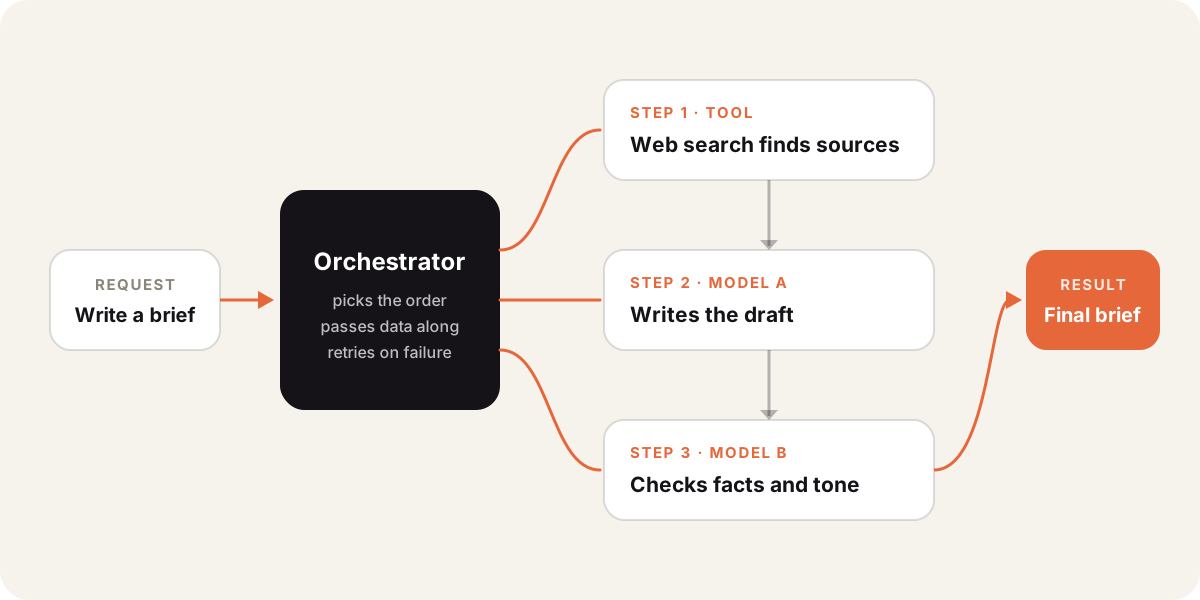
The orchestrator owns the parts that no single model handles.
| Job | What it means |
|---|---|
| Routing | Sending each step to the right model or tool |
| Ordering | Running steps in sequence or in parallel |
| Passing context | Giving each step the data it needs, and nothing more |
| Error handling | Retrying, falling back to another model or stopping |
| Limits | Capping time, cost and the number of steps |
| Logging | Recording what ran, so you can debug and audit it |
Orchestration vs agents vs workflows
The terms overlap. This is how I separate them.
- An AI workflow is a fixed set of steps.
- An AI agent picks its own steps as it goes.
- AI orchestration is the system that runs either one. It can run a fixed workflow, several agents, or a mix.
In multi-agent setups, one orchestrator agent often splits a task and hands parts to specialist agents. It then merges their results.
Where you see it
- For Model routing - Simple questions go to a fast model and hard ones to a reasoning model.
- For Retrieval - A search step fetches documents before the model answers. This is how an AI knowledge base works.
- Review steps - A second model checks the first model’s output.
- Fallbacks - If one provider is down, the request moves to another.
Multi-model chat in Sparkian is a simple, visible form of this. One prompt runs on several models side by side, and you choose the answer.
What to watch for
More steps mean more places to fail. Each hand-off can lose context, and each model call adds cost and delay. Keep the chain as short as the task allows, and log every step.