


A reasoning model is a large language model trained to work through a problem before it gives an answer. It spends extra compute on a thinking step, checks its own work and then replies.
Standard chat models start writing the answer right away. Reasoning models take longer, use more tokens and cost more. In return they do better on maths, coding, science and multi-step planning.
How reasoning models work
A reasoning model produces a long internal chain of thought, then a shorter final answer. Many apps hide the thinking or show only a summary.
The models learn this behaviour in training. DeepSeek-R1 described one method in January 2025. It used reinforcement learning to reward correct answers, and the model learned to reflect and check its steps along the way.
OpenAI’s o1, released in September 2024, made the category widely known. Most major labs now ship reasoning models or let you switch reasoning on for a model.
Reasoning model vs standard model
| Standard model | Reasoning model | |
|---|---|---|
| Starts answering | Right away | After a thinking step |
| Speed | Fast | Slower, sometimes much slower |
| Cost per request | Lower | Higher, thinking uses tokens |
| Best for | Chat, writing, summaries | Maths, code, analysis, planning |
| Prompting style | Step-by-step hints help | Clear goals matter more than hints |
Reasoning models in Sparkian
In Sparkian I can filter the model picker by Reasoning. Each model shows a reasoning level, a speed level and a starting Sparks cost.
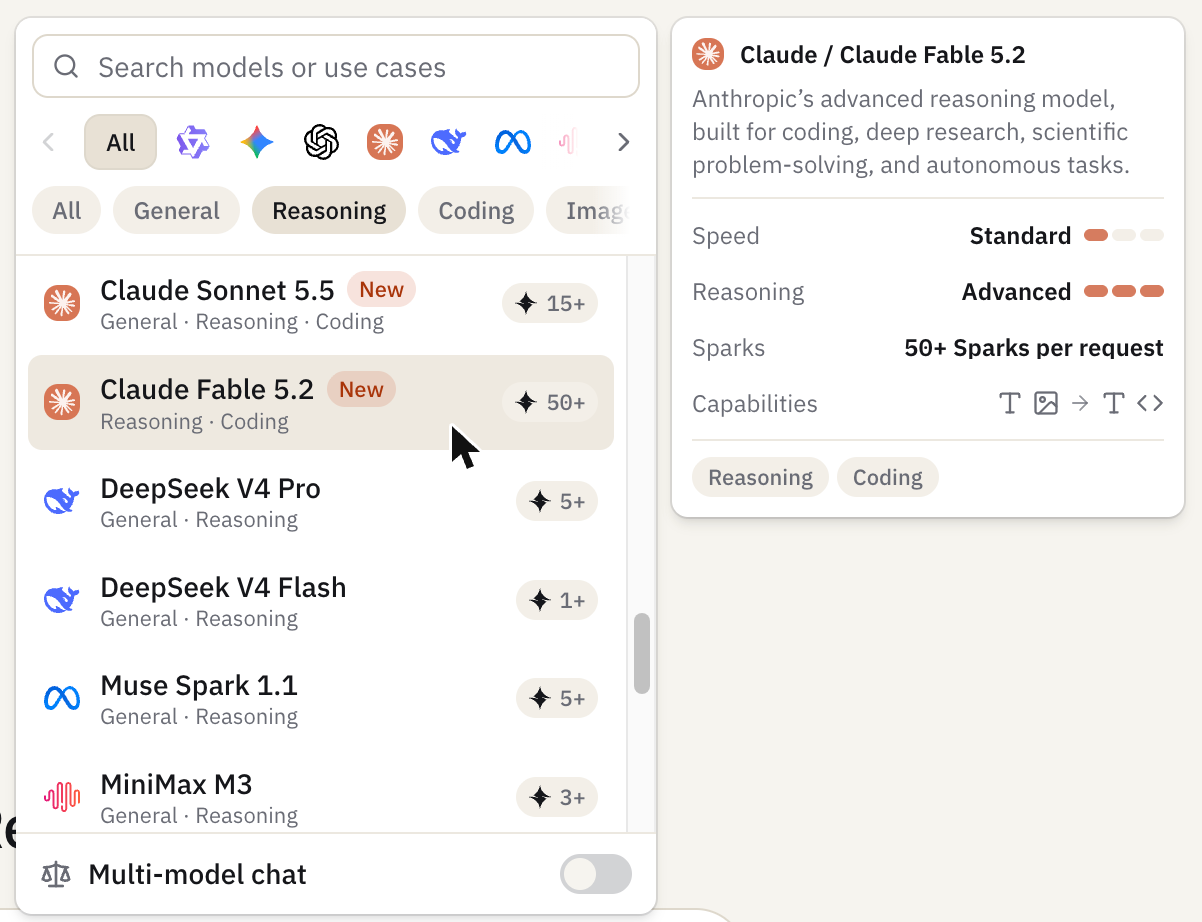
The trade-off is plain in the panel. Claude Fable 5.2 has Advanced reasoning at 50+ Sparks per request. Claude Haiku 5.5 has Basic reasoning, Fast speed and starts at 1+ Sparks.
I use a reasoning model for code review, data analysis and tricky logic. For a quick rewrite or a summary, a fast model gives the same quality in a fraction of the time.
When to use one
- Use one when an answer needs several steps, exact numbers or careful checks.
- Skip it for chat, short writing and simple lookups.
- Run the same task on a fast model and a reasoning model with multi-model chat and compare.
Reasoning lowers some errors but does not remove AI hallucination. Check facts and figures the same way you would with any model.