


An AI agent is an AI system that takes a goal and works toward it on its own. It plans steps, uses tools such as search or a browser, checks the results and keeps going until the job is done.
A chatbot answers one message at a time. An agent can take dozens of actions from a single request.
How an AI agent works
Most agents run the same loop around a language model.
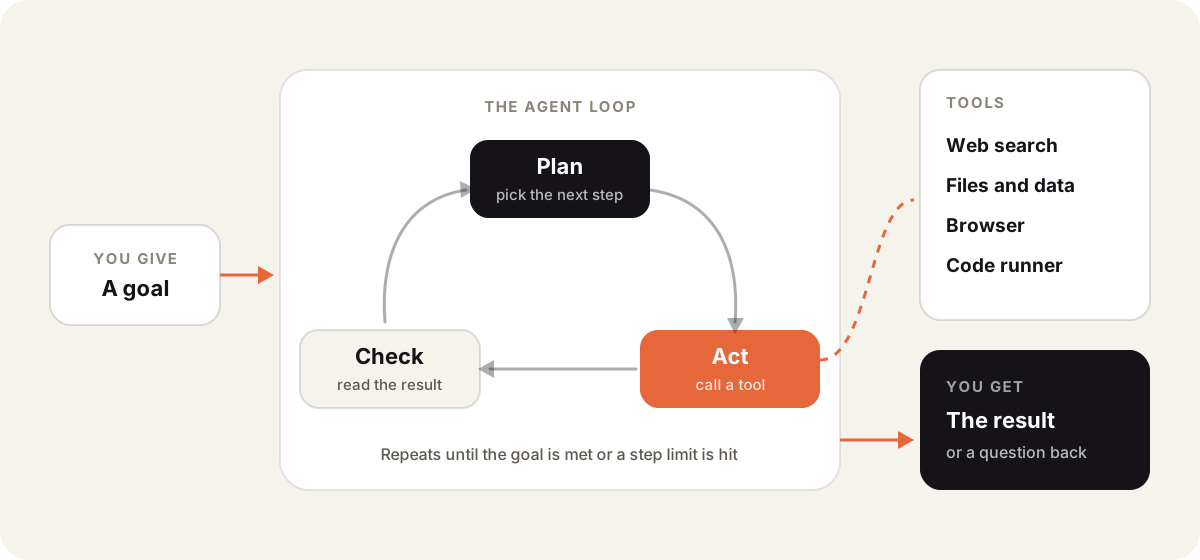
- Plan - The model decides the next step from the goal and what it knows so far.
- Act - It calls a tool. It might search the web, open a file, click a button or run code.
- Check - It reads the tool’s result and decides whether the goal is met.
- Repeat or stop - It loops again, asks you a question or returns the result.
Good agents also have limits. They stop after a set number of steps, ask before risky actions and log what they did.
AI agent vs chatbot vs workflow
| AI chatbot | AI workflow | AI agent | |
|---|---|---|---|
| Who picks the steps | You, one message at a time | You, in advance | The model, as it goes |
| Uses tools | Sometimes | At fixed points | Whenever it decides to |
| Best for | Questions and drafts | Repeated, predictable tasks | Open-ended tasks with many steps |
| Predictability | High | High | Lower |
Agents trade predictability for flexibility. If a task always follows the same steps, a workflow is usually cheaper and more reliable.
Examples of AI agents
- Coding agents read a codebase, edit files and run tests.
- Research agents search many sources and write a cited report.
- Browser agents fill in forms and compare pages for you. See AI browser.
- Support agents look up an order, follow a policy and draft a reply.
In Sparkian chat, the model itself decides when to search the web or read a URL during an answer. That is the same tool-choice step an agent uses, kept to a single reply.
Risks to know
- Errors compound - A wrong early step can lead the whole run off course.
- Cost adds up - Every loop is another model call.
- Prompt injection - Text on a web page or in a file can try to give the agent new instructions.
- Access - An agent with your logins can act as you, so give it only what the task needs.
Start with a narrow task, watch the first runs and keep a person in the loop for anything that sends, buys or deletes.