


LLM evaluation is the process of measuring how well a large language model performs. It checks whether answers are correct, useful, safe and consistent, and what they cost in time and money.
Model makers use evaluation to rank releases. Teams use it to pick a model for a job and to catch problems after a prompt or model change.
Types of LLM evaluation
| Method | How it works | Good for | Weak spot |
|---|---|---|---|
| Public benchmarks | Fixed test sets with known answers | Comparing models in general | May not match your tasks |
| Human preference | People compare two answers and pick one | Overall helpfulness | Slow and subjective |
| Judge models | Another model scores answers against a rubric | Scoring many outputs fast | Can share the same blind spots |
| Exact checks | Code tests, format checks, string matches | Clear right or wrong tasks | Misses quality and tone |
| Your own test set | Real tasks with expected answers | Choosing a model for your work | Takes effort to build |
Benchmarks include MMLU for general knowledge, GSM8K for grade-school maths and SWE-bench for real coding fixes. LMArena ranks models by votes from people who compare two blind answers. The judge model approach is often called LLM-as-a-judge, from a 2023 paper that tested it against human ratings.
Why benchmarks aren’t enough
A model can lead a leaderboard and still be the wrong pick for you. Benchmarks test general skills, and some test questions leak into training data. A high score may reflect memory, not ability.
Your tasks have your formats, your terms and your edge cases. The only reliable test is a set of those tasks.
Run a simple evaluation
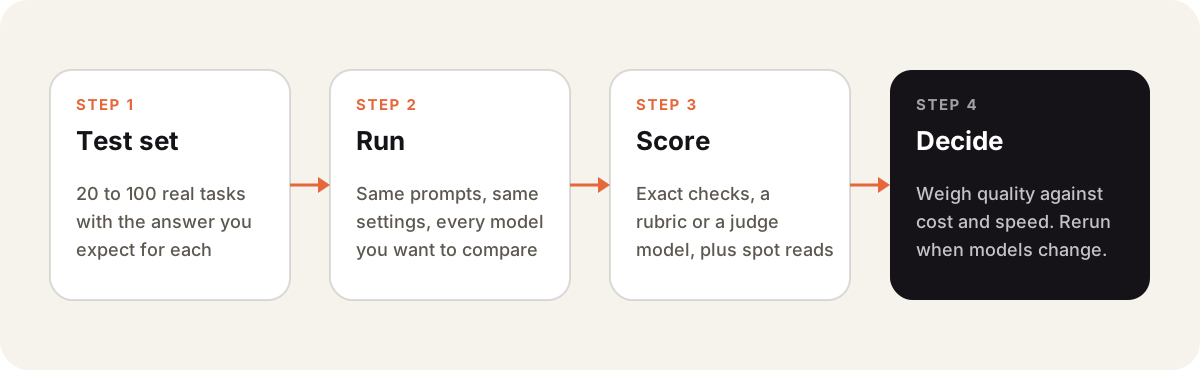
- Pull 20 to 100 real examples and write the answer you expect for each.
- Use the same prompt, settings and context.
- Use exact checks where you can, and a short rubric where you can’t.
- A slightly better answer may not be worth five times the cost.
- Test again when you change the prompt or a model updates.
Quick checks in Sparkian
For a few prompts, I don’t need a full test setup. I use multi-model chat in Sparkian to send one prompt to several models and read the answers side by side.
It is a fast way to spot which models handle a task and which ones invent facts. For anything that ships, I still keep a written test set and rerun it.
Track AI hallucination as its own metric. A fluent wrong answer often scores well on style and badly on truth.