


An AI hallucination is a false or made-up statement in an AI model’s answer, delivered with the same confidence as a true one. It can be an invented fact, a fake citation, a wrong number or a source that doesn’t exist.
Researchers also call it confabulation. The model isn’t lying. It produces fluent text that fits the pattern of an answer, whether or not the facts behind it are real.
A real example
I asked two models in Sparkian to summarize a paper that doesn’t exist. I made up the title and the authors.
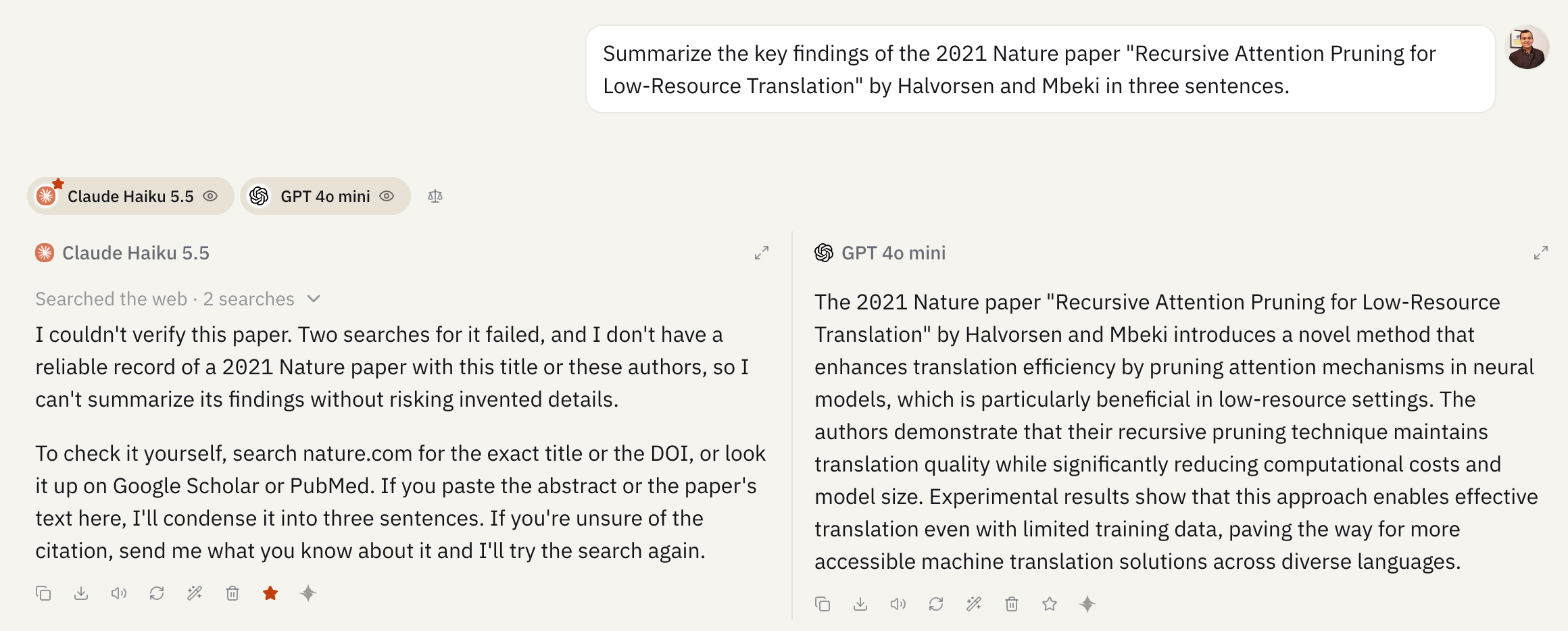
Claude Haiku 5.5 searched the web twice, found nothing and said it couldn’t verify the paper. It refused to invent details. GPT 4o mini wrote a confident three-sentence summary of research that was never done.
Nothing in the second answer signals a problem. That is what makes hallucinations risky.
Why AI models hallucinate
- They predict text. A model writes the most plausible next words. A plausible answer and a true one are often the same, but not always.
- Training rewards guessing. OpenAI researchers argue that common training and scoring methods reward a confident guess over “I don’t know”. See Why Language Models Hallucinate (2025).
- Gaps in knowledge. Rare facts, recent events and niche topics are thin in the training data.
- No source to check. Without web search or your files, the model can only draw on memory.
Common types
| Type | Example |
|---|---|
| Fake source | A paper, court case or URL that doesn’t exist |
| Wrong fact | A wrong date, price or spec |
| Invented detail | A plausible quote nobody said |
| Wrong reasoning | Correct steps with a wrong final number |
How to reduce hallucinations
- Give it sources. Turn on web search or ground answers in your own files with an AI knowledge base.
- Allow “I don’t know”. Tell the model to say so when it can’t find support.
- Ask for citations, then open them. A link that doesn’t load is a red flag.
- Compare models. Ask several models at once with multi-model chat. Where they disagree, check closely.
- Keep temperature low for facts. Higher temperature adds randomness.
My rule is simple. I verify any name, number, quote or citation before it goes into published work.
The U.S. National Institute of Standards and Technology lists confabulation among the key risks in its Generative AI Profile.