


An open-source LLM is a large language model whose weights are published for anyone to download. You can run it on your own hardware, change it and build products on it, within the terms of its license.
Closed models such as Claude, GPT and Gemini work differently. You can only use them through the company’s app or API.
Open source vs open weight
Most models people call open source are really open weight. The trained weights are public, but the training data and full training code are not.
The Open Source Initiative published the Open Source AI Definition. It asks for detail about the training data, plus the code and weights, for someone to rebuild the model. Many popular models don’t meet that bar. Some, like Llama, also add license limits on how you may use them.
| Open weight | Fully open source | Closed | |
|---|---|---|---|
| Download the weights | Yes | Yes | No |
| Training data details | Rarely | Yes | No |
| Run on your hardware | Yes | Yes | No |
| License limits | Often | Few | Terms of service |
For most users the practical question is simple. Can I download it, run it and use it commercially? Check the license of each model before you build on it.
Well-known open models
Meta’s Llama, Alibaba’s Qwen, DeepSeek, Mistral, Moonshot’s Kimi, Zhipu’s GLM and NVIDIA’s Nemotron all publish weights for at least some of their models.
Open models in Sparkian
You don’t have to host an open model to use it. I searched the model menu in Sparkian for DeepSeek and got four models with their speed, reasoning level and Spark cost.
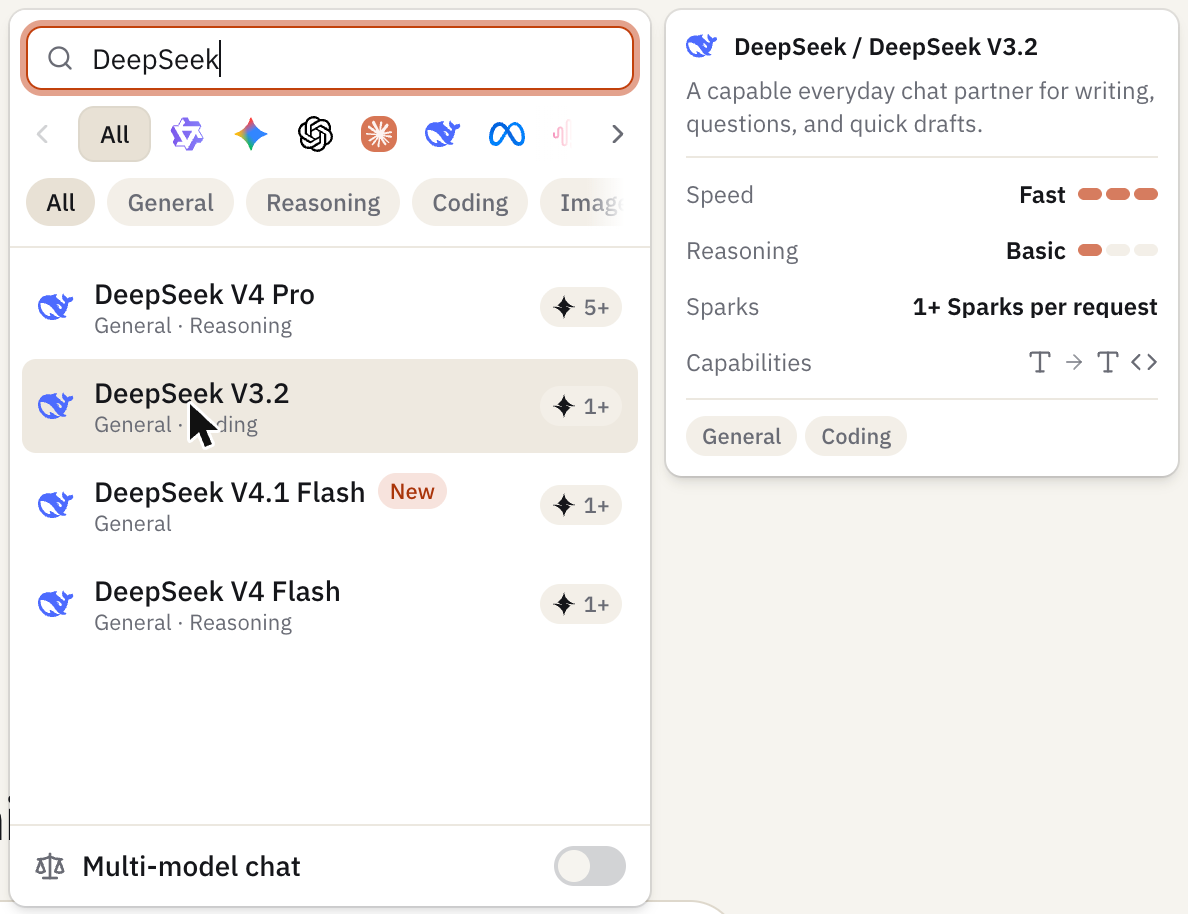
Open models are often cheaper per answer. DeepSeek V3.2 starts at 1 Spark per request here, while larger closed models cost more. They suit drafts and bulk tasks. When quality matters, compare the answer with a closed model.
Why choose an open model
- Run it where you want, including as a local LLM.
- No per-token fee when you host it yourself.
- Fine-tune it on your own data.
- The weights stay available even if the company changes its plans.