

Multimodal AI is AI that works with more than one type of data. A multimodal model can take text, images, audio or video as input, and some can produce more than one type as output.
Early chatbots were text in, text out. Today you can show a model a chart and ask what it means, or describe a scene and get back an image.
Common modes
| Input | Output | Example |
|---|---|---|
| Text | Text | Ask a question, get an answer |
| Image | Text | Upload a receipt, get the total |
| Text | Image | Describe a product shot, get a picture |
| Audio | Text | Record a meeting, get a transcript |
| Text | Audio | Paste a script, get a voiceover |
| Text or image | Video | Turn a still image into a short clip |
Some models handle several of these at once. Others do one job well, like image generation, and an app connects them.
An example in Sparkian
I turned on Create image in Sparkian chat and asked for a flat lay photo of hiking gear. The app switched to Nano Banana 2 Lite, an image model, and returned the picture in the same conversation.
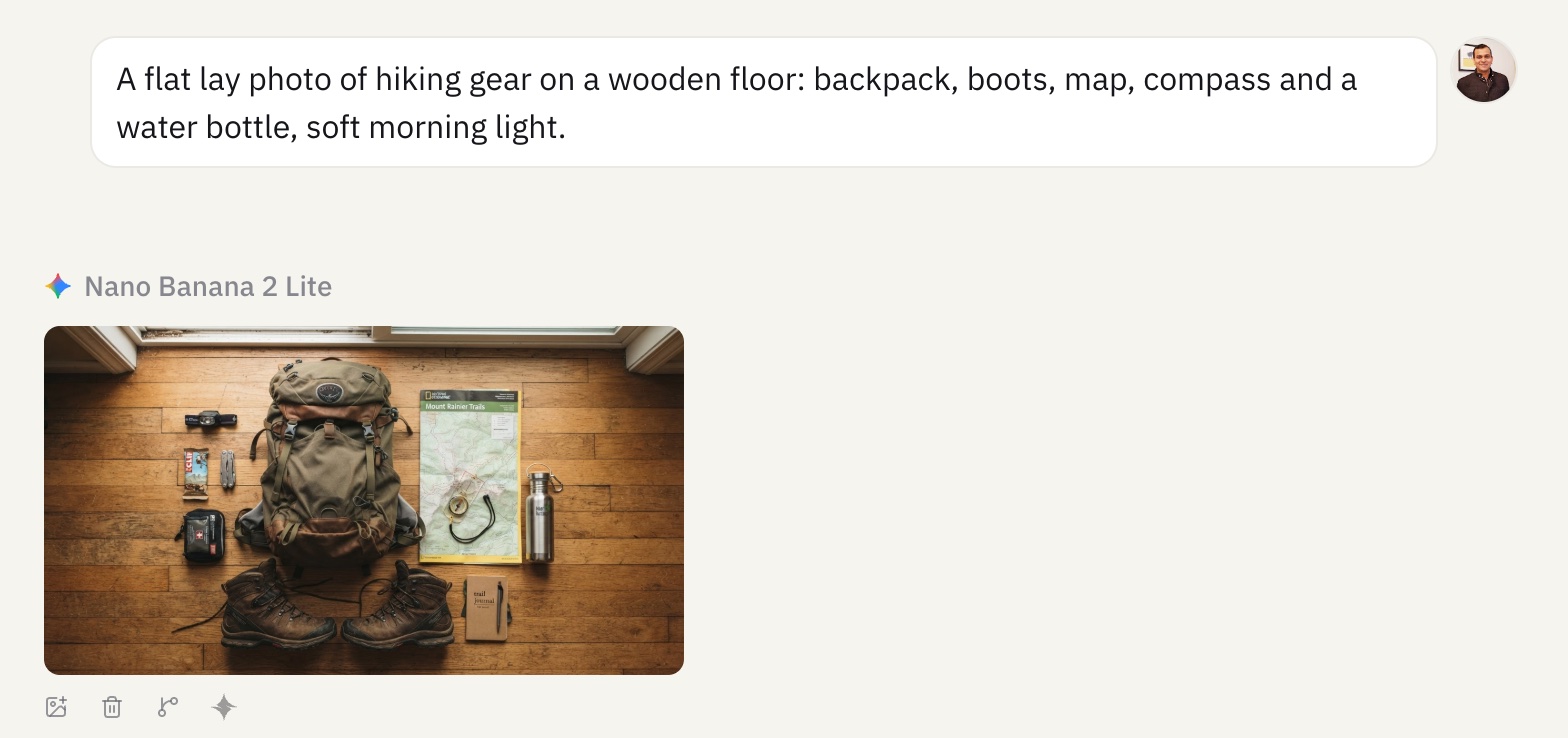
The result followed the prompt closely. It also added things I didn’t ask for, like a first-aid kit and a journal. Image models fill gaps with what usually appears in similar photos.
Why multimodal matters
- Less retyping, you can share a screenshot instead of describing it.
- Reading handwriting, checking a design or explaining a graph.
- Writing and images live in the same chat, so context carries over.
Multimodal models still make mistakes. They misread small text in images and miscount objects. I check any number a model reads from a picture.
You can browse the image models in Sparkian, such as Nano Banana, Seedream and FLUX, next to the chat models.